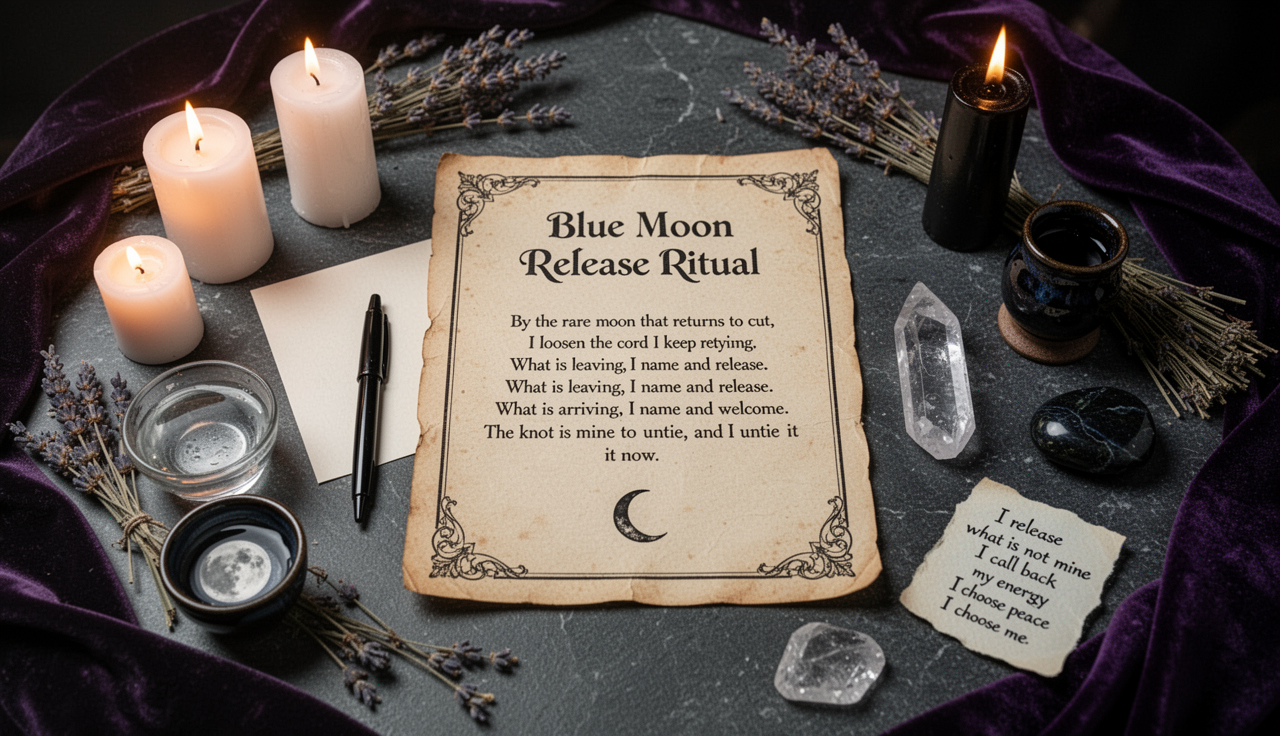
A beginner blue moon release ritual for the cord you keep retying—two candles, moon water, and the name you've been refusing to write.
I sense you felt the Blue Moon's pull last night—that restless ache that says something has to end before the next chapter can begin. You already know the name of what must go. You've known for months, maybe longer. This ritual isn't about forcing an outcome; it's about finally letting your hand release the cord you keep retying every time you feel lonely or afraid.
Timing
Moon: Blue Moon (or any full moon if a Blue Moon isn't near)
Day: the night of the Blue Moon itself
Time: after sunset, before midnight
What You Need
white candle
black candle
piece of paper
black ink pen
water in a small bowl (left under moonlight if possible)
sea salt
container with lid
fire-safe surface
rosemary
The Incantation
By the rare moon that returns to cut,
I loosen the cord I keep retying.
What is leaving, I name and release.
What is arriving, I name and welcome.
The knot is mine to untie, and I untie it now.
The Ritual
Find a quiet evening on or near the Blue Moon when you're alone in your home. Set the two candles on a fire-safe surface—white on your left for what is leaving, black on your right for what you're calling forward. This is the threshold you're building between the chapter ending and the one beginning.
Light the white candle first, then the black, taking three slow grounding breaths between them. Place the small bowl of water in front of you—if you can, set it in moonlight for a few minutes beforehand so it carries the night's reflection.
Fold your piece of paper down the center. On the left column, write what you are releasing—the attachment, the habit, the story you keep returning to. On the right column, write what you are calling toward yourself in its place. Be honest. No one else has to read this.
Hold the paper in both hands and acknowledge, without judgment, how long you've been carrying the left side. Speak the incantation aloud three times, growing quieter and more certain with each pass.
Dip your fingertips in the water and press them along the left column until the ink blurs and the words begin to dissolve. You are not destroying yourself—you are softening your grip.
Tear the left side away from the right. Place the torn left piece inside your container with a generous spoon of sea salt (and a sprig of rosemary, if using). Seal the lid. This is your symbolic burial—the salt holds what you've named.
Fold the right side toward your chest and tuck it somewhere private—under your pillow, inside a book, near your bed—for the next three nights. Let the candles burn down safely in your presence, or snuff them (don't blow) when you're ready to close the ritual.
Within three days, place the sealed container somewhere off your daily path—at the back of a closet, in an outdoor bin, or buried past your threshold if you have a yard. Disposing of it gently signals to yourself that the chapter is closed.
Frequently Asked Questions
What if there isn't a Blue Moon coming up soon—can I still do this ritual?
Yes. A Blue Moon is rare on purpose, and its symbolism—a second chance, a charged threshold, a rare cut—is the real engine of this work. If you can't wait for the next one, perform the ritual on any full moon and consciously borrow the Blue Moon's framing: 'This is my rare moment. This is the cut I've been postponing.' The moon is a mirror for intention, not a vending machine. What makes the ritual work is your readiness to stop retying the cord, not the calendar. If you want, you can repeat it lightly on the next true Blue Moon to reinforce the release.
Is this ritual going to make someone leave my life or change their behavior?
No, and that's intentional. This is severance work aimed at your own attachment, not at another person's free will. You're naming what you keep returning to, softening your grip on it, and symbolically marking the decision to stop retying the knot. Any change in an external relationship comes from the choices you make afterward—how you respond to a text, whether you walk back through a door, what you allow into your space. The ritual gives you a clear inner threshold; the living of it is still yours. If you're trying to force someone else's behavior, this isn't the spell, and honestly, no ethical spell is.
What if I cry, freeze, or can't finish the ritual?
That's information, not failure. Severance work often surfaces grief you didn't know was waiting—endings are losses even when they're chosen. If you stall partway through, snuff the candles, put the paper somewhere safe, and return to it another night. You haven't broken anything. If what comes up feels bigger than a ritual can hold—old trauma, an unsafe relationship, persistent intrusive thoughts, addiction—please treat that as a sign to bring in a therapist, counselor, or support line alongside the symbolic work. Magic and professional support are not in competition; the wisest practitioners I know use both.
What do I do with the right-side paper after three nights under my pillow?
After the third night, take the right-side paper somewhere quiet and read it once more, slowly. Then choose how to honor it: tuck it inside a journal, slide it behind a photo you love, press it into a book you re-read, or place it near a potted plant you tend. The point is to keep it somewhere you'll encounter it occasionally, so the 'arriving' side stays in conversation with your daily life. Avoid burning or burying this half—that's reserved for the left column. If at any point what you wrote no longer fits, write a new right side and replace it. You're allowed to revise what you're calling forward.